
12-Step Support at Provive Wellness
12-Step Support at Provive Wellness
Alcoholics Anonymous was founded in 1935 by two men — a stockbroker and a surgeon — who discovered something that neither medicine nor willpower alone had been able to give them: the sustained recovery that came from being in honest relationship with other people who understood the same struggle. In the nine decades since, the 12-Step model has become the most widely studied peer support framework in the history of addiction treatment. It has not endured because of institutional inertia. It has endured because, for millions of people, it works.
At Provive Wellness, 12-Step support is not a relic of an older treatment era awkwardly grafted onto modern clinical care. It is a complementary pillar of a complete recovery plan — one that addresses something clinical treatment alone cannot: the ongoing, daily, community-embedded work of staying sober in the real world, with real people, for the long term.
12-Step support at Provive is available to clients in our Partial Hospitalization Program (PHP) and Intensive Outpatient Program (IOP) at our Wayne, PA and Scranton, PA locations.

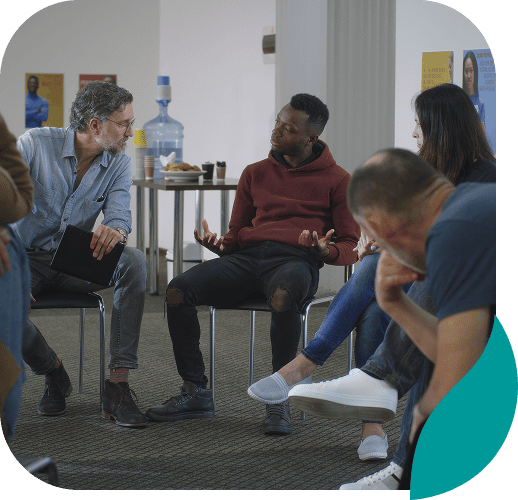
What 12-Step support at Provive includes:
- Clinical integration — 12-Step philosophy and step work are incorporated into treatment conversations from the beginning, not introduced only at discharge
- Meeting attendance as part of treatment — clients are supported in attending AA, NA, or other relevant 12-Step meetings during the treatment period and building a consistent practice
- Sponsor relationship development — clinical support for identifying, approaching, and beginning to work with a sponsor
- Step work within individual therapy — exploration of the steps in the context of individual clinical goals and history
- Connection to local fellowship — guidance toward specific meetings, groups, and communities in the Wayne and Scranton areas that clients can continue attending after discharge
The research on 12-Step programs is among the most robust in addiction treatment. A landmark 2020 Cochrane systematic review — the most rigorous form of scientific evidence synthesis — found that AA and 12-Step Facilitation Therapy was more effective than other established treatments for achieving continuous abstinence at 12-month and 36-month follow-up, and produced savings in healthcare costs compared to clinical treatment alone. The review analyzed 27 randomized controlled trials and 21 other high-quality studies and concluded that 12-Step participation produced higher rates of continuous abstinence than Cognitive Behavioral Therapy at long-term follow-up. The mechanism is increasingly well-understood: abstinence self-efficacy, recovery identity, and social network change — the three shifts that 12-Step communities are specifically designed to produce — are among the strongest predictors of sustained recovery available in the literature.
What 12-Step offers that clinical treatment cannot fully replicate is something deeply human: a community of people who have been through the same thing, who will be in the same room on Tuesday night whether or not you are struggling, who will call when you go quiet. The clinical relationship ends at discharge. The fellowship does not. For many people who have sustained long-term recovery, the rooms of AA or NA — the particular meetings, the particular people, the particular rituals — become part of how they live. Not a crutch but a community. Not a reminder of illness but a structure for living well.
- The group gathers with a licensed art therapy facilitator
- A structured prompt or theme is introduced — often connected to the clinical work of the week
- Participants work with provided materials (paint, collage, drawing tools, clay) at their own pace
- The session closes with guided reflection — sharing what came up and what was noticed
- Insights are integrated back into individual therapy and group treatment
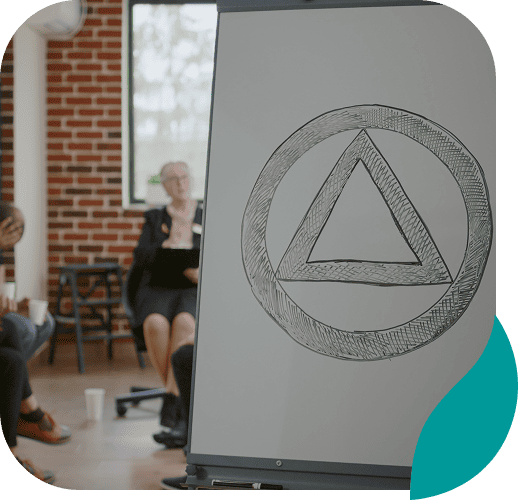
At Provive, we support clients in beginning this relationship during treatment — not at the moment of discharge, when the structure of PHP or IOP falls away and the transition is already disorienting. By the time a client leaves the intensive phase of treatment, the goal is that they know specific meetings, have been to them multiple times, and have at minimum begun to identify a sponsor. The bridge into recovery community is built before it is needed.
Provive also recognizes that 12-Step is not the right fit for everyone. For clients who prefer a secular, non-spiritual framework, SMART Recovery offers an evidence-based alternative. For those whose recovery is grounded in faith, Celebrate Recovery provides a Christ-centered fellowship. And Rooted in Recovery — Provive’s own peer community group — offers connection and accountability in a setting that complements any of these frameworks. The goal is not 12-Step specifically. The goal is community, accountability, and a recovery fellowship that each client will actually show up for.
Call us at (610) 947-0800 to begin yours or a loved one’s journey toward lasting recovery — with clinical treatment and the peer fellowship that sustains it.
Frequently Asked Questions
The 12-Step tradition uses the language of a “Higher Power as you understand it,” which has historically made the program accessible to people with a wide range of spiritual beliefs, including those who are agnostic or atheist. Many AA and NA meetings today welcome non-theistic members, and secular 12-Step meetings (such as AA Agnostica) exist specifically for those who want the fellowship without the explicitly theistic framing. Your clinical team can help you find meetings that match your orientation. If you prefer a fully secular framework, SMART Recovery may be a better fit.
Alcoholics Anonymous is specifically focused on alcohol use disorder, while Narcotics Anonymous addresses all substance use disorders. Many people attend both, and there are a range of other fellowships — Cocaine Anonymous, Crystal Meth Anonymous, Gamblers Anonymous, and others — for specific substances or behaviors. Your clinical team will help identify the most relevant fellowship for your specific situation.
Finding a sponsor is part of what Provive supports during treatment. Your clinical team will help you understand what to look for in a sponsor, how to approach someone, and how to begin working the steps. Most sponsors are identified through regular attendance at the same meeting — the relationship grows from consistency. We encourage clients to begin attending specific meetings during treatment so that they arrive at the fellowship as a familiar presence rather than a stranger.
Many factors influence whether a 12-Step experience feels effective — the timing, the specific meeting, whether clinical treatment was happening alongside it, and whether a sponsor relationship was in place. Treatment that integrates 12-Step support clinically — rather than simply referring someone to meetings — tends to produce better engagement and outcomes. That integration is what Provive offers. If 12-Step remains a poor fit after an honest attempt, other pathways including SMART Recovery and Celebrate Recovery are available.
Yes. AA, NA, and related 12-Step fellowships are fully free to attend. Meetings pass a basket for voluntary contributions to cover room costs, but attendance costs nothing and no contribution is expected.
Yes, and we actively encourage it. Attending meetings during the treatment period — rather than beginning only after discharge — allows you to build real relationships and familiarity with specific meetings before the structure of treatment ends. Your treatment schedule will be coordinated to support meeting attendance where possible.
The Provive Difference

PERSONALIZED CARE
Innovative treatment tailored to you. Our experts embrace the latest in evidence-based practices to help patients get results.

SUPPORTIVE STAFF
You’re not alone. Our staff understands the challenges of overcoming addiction and provides support at every step.

HOLISTIC APPROACH
Physical health is just one piece of the puzzle. We help patients achieve optimal wellness in mind, body, and spirit.
Some Insurance Plans we work with include:


The journey to wellness starts with a single step
Contact our team to learn more about the programs and resources available at our Wayne and Scranton locations.


